Table of Contents
Social media marketing for business helps you build brand awareness, engage clients, but also generate leads for sustainable business development. A strong social media strategy can improve your online presence and drive sustainable business growth.
Various people today use social media while shopping, searching for products and establishing business communication.
Social Media Marketing for Business Development
Social media marketing for business is an integral part of the modern marketer’s toolkit and goes far beyond occasional posting.
Indeed, when used the right way, social media marketing can open new doors for businesses, help connect with customers, enhance brand image, etc.

What Is Social Media Marketing for Business?
Thus, it can be said that social media marketing for business means utilizing Facebook, Instagram, LinkedIn, YouTube, TikTok and similar platforms to promote one’s business, audience, and goals.
- A successful strategy can include:
- Creating educational and promotional materials
- Establishing market awareness
- Maintaining dialogue with customers
- Generating leads
- Bringing traffic to the website
- Advertising products and services
- Collecting customer insights
- Creating an online community
- Tracking marketing results
Using the right social media marketing techniques for business should depend on the specific business, target audience, industry, budget, and advertising objectives.
Why Social Media Marketing Is Important for Businesses
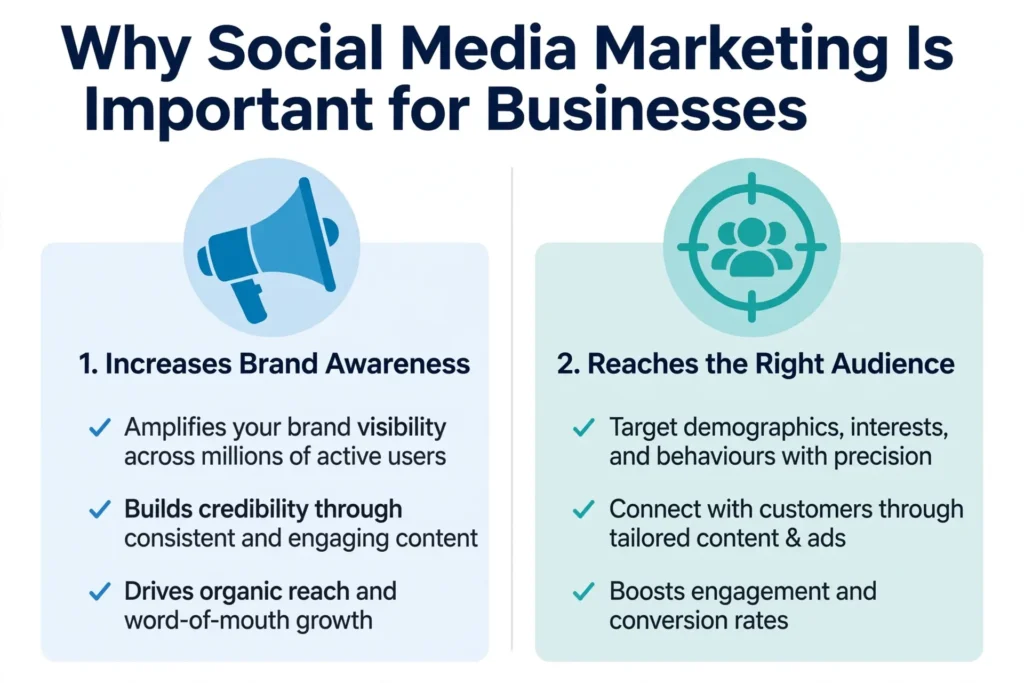
Social networks allow businesses to communicate directly with their current and potential customers. Unlike traditional advertising channels, companies can engage their audience in conversations about their products, services, expertise, and brand values.
- 1. Increases Brand Awareness
- Through constant activity on social media marketing for business , your company can keep itself among the potential customers. Useful posts, videos, stories, and discussions will help make your brand recognizable in the long run.
- 2. Reaches the Right Audience
- Social media platforms offer targeting and content discovery options that can help companies to find interested people.
- 3. Improves Customer Relationships
- It can be noticed that the customers appreciate companies that listen and reply. This will create stronger bonds with the clients and enhance the customer experience overall.
- 4. Aids in Generating Leads
- Social media marketing for business posts direct interested individuals to landing pages, forms of contact, product pages, newsletters, or other opportunities for conversion.
- 5. Enhances Web Traffic
- The right social media posts can lead people to your website in search of additional details, creating yet another avenue for potential customers to find out about your company.
- 6. Offers Insights About Customers
- Through comments, messages, reviews, and engagement patterns, businesses can understand what their customers like, dislike, inquire about, and expect.
Define Your Target Audience Social Media Marketing Strategy
An effective strategy helps make sure that you are not just posting randomly, but that your marketing actions are more focused.
Step 1: Define Your Marketing Goals
Decide what you want to do.
“If you want to achieve something, you should know your goals.”
Social media marketing for business goals could be:
- Growing awareness of your brand
- Finding good prospects
- Making more engagement with your audience
- Getting more visitors to your website
- Announcing the arrival of a new product
- Increasing brand loyalty
- Selling more online
Make the goals measurable to know if you are successful in implementing your strategy.
Step 2:Define Your Marketing Goals
Learn about your target audience
“Find out about the people that you want to influence.” You should gather information about their needs, interests, problems they encounter, behavior when buying, content they consume, and how they use social media.
The better you know your audience, the easier it will be for you to prepare relevant content.
Stage 3: Select the Right Platforms
Pick the Perfect Platforms
You are not under any obligation to be active on all social media sites.
A good example is the selling of professional services which is better suited to LinkedIn while businesses that revolve around visuals find Instagram or TikTok to be a better option.
Make sure that your resources are mostly focused on the platforms that your potential customers use.
Stage 4: Develop a Content Strategy
Create a Content Plan
A successful content strategy is one that varies different post types so that not only products are accepted.
Think of making available:
- Educational material
- Guides
- Tips in the industry
- Client stories
- Rumors from behind the scenes
- Short videos
- Demonstrations of products
- Common questions
- News from the company
- Promoting content
The idea remains the same – the audience must get useful and interesting information so that certain products are introduced to the public naturally.
Stage 5: Make the Brand Consistent
It is important to have recognizable brand identity in social media profiles. Use colors, style of visuals, words, and approach keeping it aligned.
Step 6: Engage with Your Audience.
Social media is meant to be interactive. This means you should not use it as a mere channel for advertising.
You should answer the comments and messages, participate in the discussions on the subject matter, ask questions, and allow your customers to write about their impressions.
Meaningful engagement is a way to convert followers into a loyal community around your brand.
Step 7: Analyze Your Results.
Track the performance indicators that will help you understand what works.
Some important metrics are:
- Reach
- Impressions
- Engagement Rate
- Growth in Followers
- Clicks on the Website
- Leads
- Conversions
- Vides Views
- Cost per Result for Paid Campaigns
Yet, do not get stuck on the number of followers only. Sometimes a smaller audience that interacts with your content and becomes a customer is more important than a large audience that does not engage with you at all.
Organic and Paid Social Media Marketing
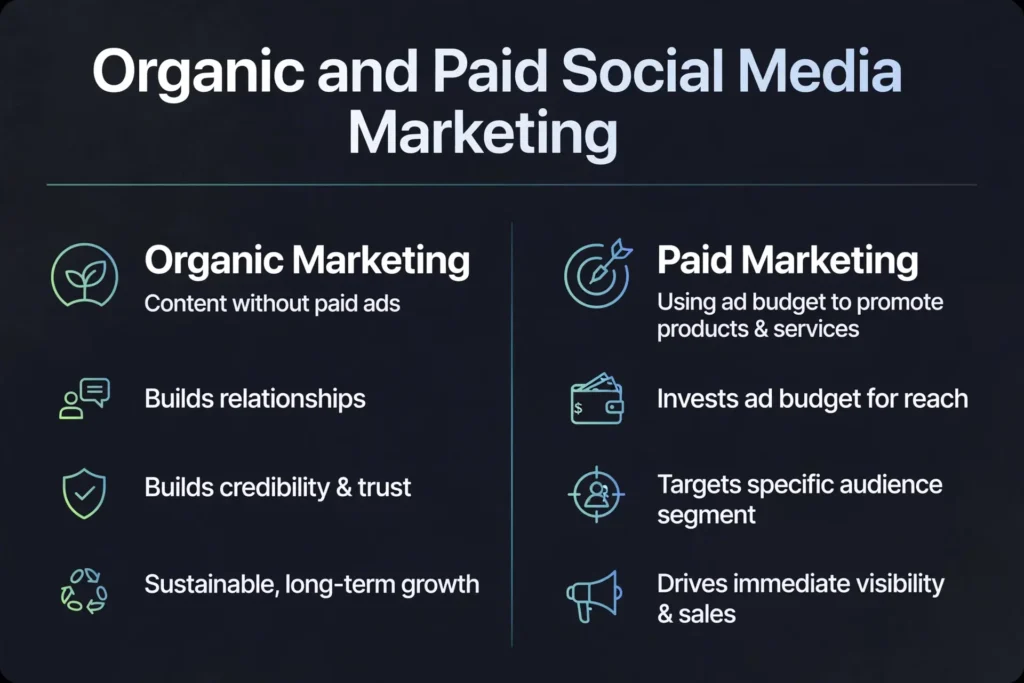
Two complementary approaches are typically used by businesses: organic social media and paid social advertising.
Organic marketing is the use of content and engagement that does not rely on paid advertisement. This approach is important to gain relationships, build up credibility, and create a sustainable brand image.
Paid social media marketing implies using advertising funds to engage particular publics and promote certain offers, products, services, or content.
Combining the two approaches can lead to a more effective strategy. Organic content serves to build trust and community, while paid campaigns can help in reaching a bigger audience and in achieving business goals.
Common Social Media Marketing Mistakes to Avoid
Frequent social media marketing mistakes to avoid
Posting Without a Clear Purpose
Even with good products, companies may still experience difficulties in using social media due to the lack of a good strategy.
Concentrating on promotions
A stream that is just a stream of advertisements can become monotonous and repetitive. Spice up your product promotions with content that is informative, helpful, educational, entertaining, and useful.
Ignoring Comments and Messages
Disregarding questions and messages
Your audience may see unanswered questions as a sign of disinterest.
Using All the Channels
Managing too many platforms can impact your content quality and consistency. Select the right channels based on your audience and the resources at your disposal.
Not Having an Effective Measurement System
Not Measuring Performance
Without measuring your results, it will be hard to find out which content is effective and whether your marketing efforts are justified.
Suggestions for Improving Social Media Results
When trying to enhance your social media marketing, it is important to focus on the quality of the content rather than just increasing the number of posts.
- Address issues of real customers.
- Use good visuals and simple communication.
- Experiment with short videos.
- Provide valuable tips from your field.
- Make use of your successful content by turning it into various formats.
- Try different headlines, visuals, and calls to action.
- Answer customers’ questions as fast as possible.
- Check important statistics often.
- Use the same tone of your branding.
- Improve your plan according to the statistics.
The Future of Social Media Marketing in Business
Social media marketing for business still changes due to the changes in consumer behavior and technological advances. A successful business is one that focuses less on acquiring followers and more on creating experiences that mean something to people.
Successful social media plans will rely on authentic communication, engaging video content, building communities, personalized messages, and data-informed decision processes.
Businesses must also be flexible because a platform or content type that works well today may fail to deliver the same results tomorrow.
Final Thoughts
Social media marketing for business is a strong way to attract attention to your company and to engage customers. However, this does not mean you post content without any plan and hope for the best.
Be sure to think of what you want to achieve, know who you target, choose social media platforms properly, create informative content, and keep engaging with your audience.
Want to grow your business with social media marketing? Explore my website to learn how I help brands grow with simple strategies.